
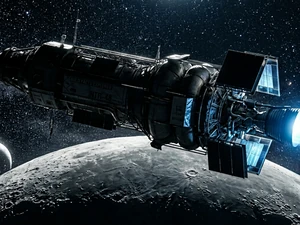
NASA Is Planning the First Nuclear-Powered Spacecraft in History
By Dana Whitfield. Mar 28, 2026
For most of space exploration history, reaching the moon meant planting a flag and coming home. NASA’s new plan changes that framing entirely. At an event called “Ignition” held at NASA headquarters in Washington on March 24, 2026, Administrator Jared Isaacman outlined a sweeping overhaul of the agency’s Moon-to-Mars strategy — one built around permanence, nuclear power, and an urgency driven by direct competition with China.
The centerpiece is a $20 billion commitment over seven years to construct a permanent lunar base near the moon’s south pole. The Gateway space station, which had been under development in lunar orbit and was already partly built, has been paused and its components redirected toward the surface base. “This time,” Isaacman said, “the goal is to stay.”
The Nuclear Spacecraft
Alongside the lunar base announcement came one of the most technically significant disclosures in NASA’s recent history. The agency confirmed plans to launch a spacecraft called Space Reactor-1 Freedom — SR-1 Freedom — to Mars before the end of 2028. It will be the first nuclear-powered interplanetary spacecraft ever built.
SR-1 Freedom will use nuclear electric propulsion, a technology that provides highly efficient thrust in deep space and remains effective far beyond Jupiter, where solar panels cannot generate enough power to be useful. According to NASA’s official release, the mission will demonstrate nuclear propulsion in operational space conditions for the first time, establishing the regulatory and technical precedent for future fission-powered missions. When SR-1 Freedom reaches Mars, it will deploy a payload of small Ingenuity-class helicopters to scout the planet’s surface.
A Three-Phase Lunar Plan
The lunar base will be constructed in stages. The first phase focuses on robotic missions under NASA’s Commercial Lunar Payload Services program, using frequent landings to test power generation, communications, and mobility systems on the surface. The second phase establishes semi-habitable infrastructure and begins recurring astronaut operations with international partners from Canada, Italy, and Japan. The third phase, contingent on sufficient cargo-capable landers, transitions to a fully permanent base.
Artemis III is currently targeted as a crewed lunar landing mission in 2028, alongside Artemis IV, with NASA’s stated goal of establishing recurring surface operations through that year. NASA’s acting associate administrator acknowledged that SpaceX and Blue Origin, both developing lunar landers, have fallen behind schedule and are working to accelerate development.
The Stakes Behind the Announcement
The backdrop to all of this is a direct space race with China, which is targeting a crewed lunar landing around 2030. Isaacman was explicit about the competitive pressure. “The clock is running in this great-power competition,” he said in his formal statement, “and success or failure will be measured in months, not years.” Reuters reported that the changes are reshaping billions of dollars in existing contracts across the Artemis program as companies scramble to realign with the new priorities.
The Planetary Society has estimated that NASA will have spent approximately $107 billion on return-to-moon plans through 2026 in inflation-adjusted dollars, with much of that investment shaped by successive changes in direction across presidential administrations. The Ignition event represented the latest — and perhaps most ambitious — of those redirections.
What Nuclear Propulsion Changes
The significance of SR-1 Freedom extends well beyond its Mars mission. Nuclear electric propulsion dramatically reduces travel time for deep-space missions and enables sustained power generation far from the sun. If the technology is successfully demonstrated in 2028, it opens the door to crewed Mars missions, outer planet exploration, and long-duration operations that solar-powered systems simply cannot support.
NASA is developing SR-1 Freedom in partnership with the U.S. Department of Energy, which has the technical infrastructure for fission systems. The agency described the mission as moving nuclear propulsion “from the laboratory to deep space” — a transition that researchers and engineers have been working toward for decades without a concrete launch date attached.
A Moment Worth Watching
The Artemis II launch in the coming days will be the first real test of whether this new phase of ambition can hold its schedule. If it does, the sequence that follows — a lunar landing in 2028, a nuclear spacecraft en route to Mars, and the early infrastructure of a permanent moon base — would represent a genuine turning point in the history of human spaceflight. The plan is extraordinary. Whether the timeline holds will be the story of the next several years.
References: NASA Announces Near-Impossible Space Plans Including $20B Moon Base and Humanity’s First Nuclear-Powered Interplanetary Spacecraft | NASA to Spend $20 Billion on Moon Base, Cancel Orbiting Lunar Station | NASA Unveils Initiatives to Achieve America’s National Space Policy

The Topline News team was assisted by generative AI technology in creating this content
Trending

Earn Massive Cash Back With This Card
Sponsored

Three Women Charged in Daylight Murder of Young Mom
Alex Morgan

The Dumb Money Mistake Most People Make
Sponsored

'Get Him Out of Here' - Judge Orders Gilgo Beach Killer Removed After Families Speak
Alex Morgan

These 14 Benefits Could Save Seniors Thousands
Sponsored

Texas Psychics Charged After Telling Victims a Curse Required a Corvette
Alex Morgan

Actor From 'Elf' and 'Friday' Arrested After Missing Child Support Hearing
Jordan Reyes

James Harden Pulled Over at 3 A.M., Booked by Dawn
Taylor Bennett

Georgia Couple Arrested for Murder After Bartender Found Dismembered in Reservoir
Dana Whitfield

Actor From 'Top Gun: Maverick' Killed at Home - Arrest Made
Taylor Bennett

They Planned Drone Bombs Over the Crowd. A Teenager's Mother Called the FBI.
Dana Whitfield

Jury Rejects Self-Defense, Sends Teen to Prison 35 Years for Track Meet Killing
Taylor Bennett

Mail Carrier Killed Months After Losing Her Husband
Taylor Bennett

Cold Case Investigator Says Marilyn Monroe's Death Scene Was 'Too Pristine'
Jordan Reyes

Pastor Dies Hours Before Facing Wife's Murder Charge
Jordan Reyes

Mark Sanchez Stabbed 4 Times - Now Faces Prison
Alex Morgan

Husband Sentenced to Life in Au Pair Murder Case
Taylor Bennett

Mom's Birthday Text Came Hours Before Daughter Killed Her
Jordan Reyes

Nicole Brown Simpson Said 'I'd Rather Die' - Her Ex Finally Speaks
Dana Whitfield

Missing Royal Caribbean Crew Member Found Dead in St. Kitts
Dana Whitfield

Alex Murdaugh's Murder Convictions Are Gone - He Is Still in Prison
Jordan Reyes

IRS Agent Gets Life in Prison After Double Murder Plot With Family's Nanny
Alex Morgan

Teens Paid to Shoot and Film It. A Veteran Cop Was Killed Trying to Stop Them.
Jordan Reyes

Psychotherapist, New Mom, Stabbed to Death at Home
Dana Whitfield